Mastering Restaurant Conversation in English: A Complete Dialogue Guide
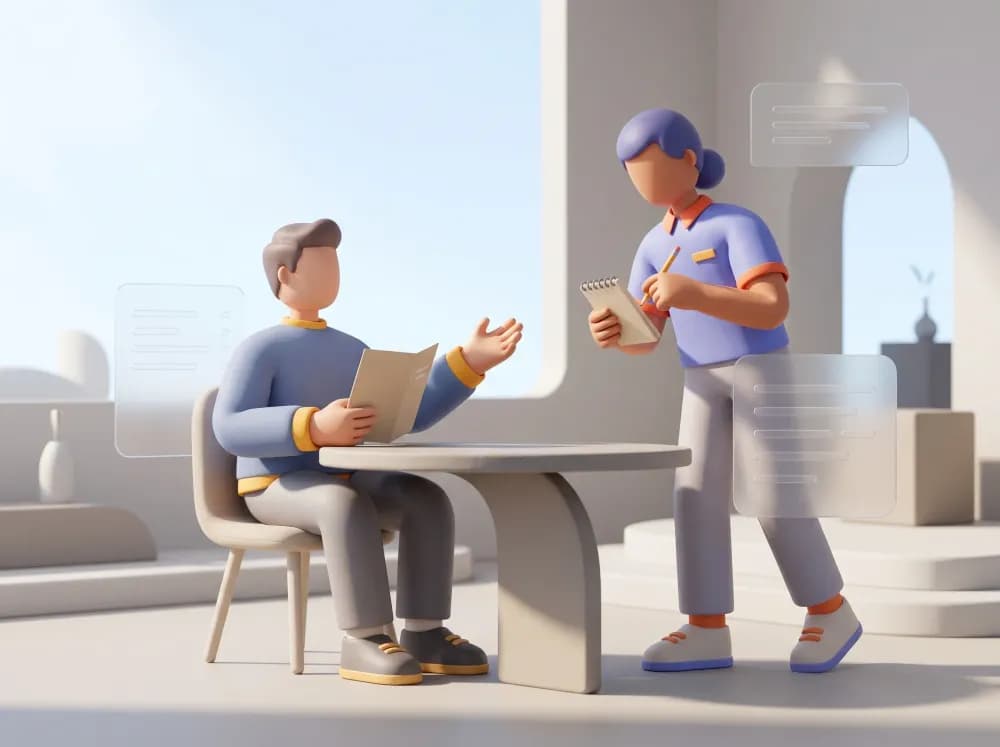
Learn natural phrases for every restaurant conversation in English. Get chronological dialogue scripts for ordering and paying with confidence.

The moment your mind freezes when a server asks a quick question, or when you need to flag an allergy and the words aren't there, is the core friction of dining out in English. This friction occurs within a predictable system, as English-speaking restaurants operate according to established conventions: hosts manage seating, and servers follow a sequence of check-ins. These conventions actually keep the whole interaction moving seamlessly from arrival to payment in a specific order, meaning that understanding this structure is the key to confidence.
This guide maps every stage of that sequence, with exact dialogue scripts for each. The phrases are drawn from how people actually speak in casual dining settings rather than from textbook formality. By the end, you'll have a complete set of tools for navigating any English language restaurant conversation.
Key Takeaways
Below are the key takeaways in this guide:
- A restaurant visit follows a predictable sequence, and each stage has its own reliable phrases.
- Natural spoken English at restaurants uses casual verb forms ("I'll do the salmon," "Can I get a refill?") rather than the formal constructions common in textbooks.
- Dietary restrictions and order problems each have exact phrasing that lands as polite and clear. Knowing the right words makes the exchange simple rather than stressful.
- Tipping customs and bill payment processes differ between American and British dining contexts. Understanding these differences prevents confusion at the end of the meal.
- Reading dialogue builds recognition. Producing it out loud under mild time pressure is a different skill that requires its own practice.
How to start a conversation in a restaurant
The opening exchange sets the tone for the whole meal. In most English-speaking restaurants, the conversation starts the moment you walk in. It follows a fairly predictable rhythm whether you have a reservation or not. The phrases below cover the three most common entry points: arriving with a booking, walking in without one, and making a reservation by phone.
Step 1: booking and arriving
English-speaking restaurants typically assign a host or hostess to manage the entrance and seat guests. The first thing the chronological script requires is this: you wait at the entrance rather than seating yourself. At most sit-down restaurants, a sign near the door will read "Please Wait to Be Seated." Walking past it to find your own table is one of the most common missteps international diners may make, and it creates friction before the meal has started.
Arriving with a reservation:
- Host: Hi, welcome in! Do you have a reservation?
- You: Yes, I have a reservation under [your name] for two, at 7 o’clock.
- Host: Perfect, right this way.
Walking in without a reservation:
- Host: Hi there! Do you have a reservation with us tonight?
- You: We don’t, no. Do you have any tables available for two?
- Host: We do, it’ll be about a 10-minute wait. Can I get a name for the wait list?
- You: Sure, it’s [your name].
Making a reservation by phone:
- You: Hi, I’d like to make a reservation for Saturday evening – two people at 7:30, if possible.
- Host: Absolutely. Can I get a name for the reservation?
- You: It’s [your name].
- Host: Great, we’ll see you Saturday at 7:30.
Step 2: Ordering your meal like a native speaker
The ordering phase is where textbook English and spoken English diverge most visibly. The table below shows how that plays out across the most common ordering situations. ESL materials often teach forms such as "I would like to order" or "I desire to eat the fish," which are grammatically correct but may sound stiff in casual dining settings. Native speakers use contracted, casual verbs instead. To help you make this shift, Loora includes a "Say it like a native" feature. It works as a passive feedback tool within your conversation; after you speak, the app provides a rephrased version of your sentence to show how a native speaker would naturally express the same thought. By reviewing these suggestions, you can learn more authentic expressions and practice them aloud to build muscle memory:
| Textbook English | Natural Spoken English |
|---|---|
| I would like to order the chicken, please. | I’ll do the chicken, thanks. / I’ll have the chicken. |
| Could you tell me what you recommend? | What's the speciality? What's the dish of the day? |
| I would like sparkling water, please. | Can I get sparkling water? |
| I am ready to order. | We’re all set. / I think we’re ready. |
| I desire to know the specials. | What are today’s specials? |
| What is the confit? | Sorry, what exactly is the confit? |
| Please explain the crudo dish. | I'm not familiar with that, what does the crudo taste like? |
| I do not understand the ingredients. | What does that dish come with? |
The shift is mostly in verb choice. “I’ll do,” “Can I get,” and “I’ll have” are the workhorses of restaurant ordering. They’re casual, natural, and exactly what servers expect.
Asking about specials:
- You: What are the specials today?
- Server: We’ve got a pan-seared halibut and a short rib risotto.
- You: That risotto sounds great, I’ll do that.
Asking for a recommendation:
- You: I’m torn between the steak and the salmon. What would you go with?
- Server: Honestly, the salmon’s been really popular tonight. It’s great.
- You: Perfect, I’ll go with the salmon then.
Ordering for the full table:
- Server: Are you ready to order?
- You: I think so. I’ll have the Caesar salad to start, and the lamb for my main. She’ll have the pasta.
- Server: And anything to drink besides water?
- You: Can we get a bottle of the house red?
If the server asks if you are ready to order but you need a few more minutes, a simple phrase will do. You can say: “Not quite yet, can we have a few more minutes please?” or “Could you give us a minute? We’re still deciding.” These phrases are polite, clear, and manage the server’s expectation without creating friction.
Handling dietary restrictions and allergies
Dietary restrictions require precise, unhurried language. The most effective approach is to name the restriction first, then ask the specific question:
- Nut allergy: “I have a nut allergy. Is there anything in this dish I should know about?”
- Vegan: “I’m vegan. Is the pasta made without eggs or dairy?”
- Gluten-free: “I need to eat gluten-free. Can you check with the kitchen on the risotto?”
- Dairy-free: “I’m dairy-free. Does the sauce contain any cream or butter?"
Notice how the word “need” here signals seriousness without aggression. If the allergy is severe, adding “It’s a serious allergy, so I want to make sure the kitchen knows” ensures the message reaches the right person.
Step 3: During the meal: making requests and cultural nuances
English doesn’t have a required pre-meal phrase equivalent to “Bon appétit.” When food arrives, servers typically say “Enjoy!” and responding with “Thank you” is natural and expected.
During the meal, the most common interactions are requests for extras. The baseline formula is: “Could we get [item], when you get a chance?” The phrase “when you get a chance” is a social softener. It signals that the request isn't urgent and prevents it from being perceived as demanding.
Asking for extras:
- "Could we get some more bread when you get a chance?"
- “Can I get a refill on the water?”
- “Could we get an extra set of napkins?”
- “Excuse me, could I get some ketchup for the table?”
“Excuse me” here functions as an attention signal instead of an apology. It's the appropriate way to flag down a nearby server.
Common scenarios: how to politely handle problems
Unexpected issues at a restaurant, like a wrong order, cold food, or a dirty glass, are situations where the difference between aggressive and polite phrasing, while narrow, can be socially significant. The solution is to use softeners like "a bit," "I think there might be," or "I'm not sure, but."
| The Problem | Too Aggressive | Polite & Natural |
|---|---|---|
| Cold food | This is freezing. Take it back. | Excuse me, my food is a bit cold. Could you heat this for me? |
| Wrong order | This isn’t what I ordered. | I think there might be a mix-up. I ordered the salmon, not the steak. |
| Dirty glass | This glass is dirty. | Sorry to bother you, could I get a new glass? This one has a spot on it. |
| Long wait | Where is our food? It’s been forever. | Excuse me, we’ve been waiting about 30 minutes. Could you check on our order? |
Loora’s role-play feature is perfect for rehearsing these sensitive interactions, such as sending food back or correcting a mistake, under pressure. To prepare, you can use the daily conversation feature beforehand to build comfort with the core vocabulary of apologies and clear requests in a low-stakes setting.
In each case, the polite version accomplishes the same goal as the aggressive one while maintaining a cooperative rather than confrontational tone.
Step 4: Asking for the bill and a bit on tipping culture
The final stage involves two distinct cultural norms that differ significantly between American and British dining contexts.
In the United States, servers typically take your credit card away from the table to process payment – this is standard practice. The check first arrives in a small folder, you then place your card inside, the server takes it, returns with a receipt, and you write your tip and signature.
In the United Kingdom and most of Europe, the server instead brings a handheld card reader to the table. You process the payment yourself, and the machine will typically prompt you to add a gratuity on-screen.
| American English | British English |
|---|---|
| Check | Bill |
| To-go box | Doggy bag |
| Tip | Gratuity |
| Server | Waiter / Waitress |
| Entrée (main course) | Main |
Asking for the check:
- "Could we get the check when you get a chance? (U.S.)
- “Could we have the bill, please? (U.K.)”
Splitting the bill:
- “Could we split that? We’ll each put half on our cards.”
- "Could we do separate checks? (U.S.)
- "Is it possible to split the bill? (U.K.)
Requesting a to-go box:
- "Could I get a box for this? (U.S.)
- "Could I get this wrapped up? (U.K./informal)."
Tip on tipping: in the United States, 18–20% is typically the standard expectation at sit-down restaurants. In the U.K., 10–12.5% is appreciated but not obligatory in the same way. In many continental European countries, rounding up the bill is the norm. If a service charge is already listed on the bill, make sure to check whether it's included first before adding more on top.
How to practice your restaurant conversation before dining out
There's a meaningful difference between reading a dialogue and producing one in real time. Reading builds recognition: you see the phrase, it registers, and you understand it. But in an actual restaurant, the server is already moving to the next table, the ambient noise is up, and the phrase has to surface immediately, in the right form, without a search.
You already have the vocabulary from this guide. The gap isn’t knowledge — it’s the fact that reading “I’ll have the salmon” and being able to say it smoothly while tracking the server’s reaction and deciding what to order next are completely different tasks. That gap doesn’t close with more reading. It closes with practice.
Why practice is what closes the gap
When you read a phrase, it enters your memory as something you know. When you say it out loud, under pressure, in a real exchange, it starts moving into a different kind of memory — the kind that doesn't require you to think. That's the difference between knowing a phrase and owning it.
Think about the first time you drove a car. You thought consciously about every action — mirror, signal, speed, distance. After years of driving, you do none of that consciously. Your hands just know. Language works the same way. Fluency isn't knowing the right phrase faster. It's not having to search for it at all.
The only thing that builds that automatic retrieval is spoken practice — specifically, practice in conditions that feel close to the real thing. Not memorising scripts. Responding to prompts, handling unexpected questions, recovering when you don't catch what the server said. That is the practice that transfers.
Confidence at the table — and the courage to ask when you don't know
One goal of this practice is to feel confident enough that ordering doesn't occupy your mental energy. When you're not spending effort on the mechanics of the phrase, you can actually enjoy the meal.
But confidence doesn't mean pretending to know everything. Native speakers ask questions too. If the server describes a special and you don't catch a word — a cooking method, an unfamiliar ingredient — asking is exactly what a fluent speaker does:
- "Sorry, could you tell me more about how that's prepared?"
- "What does that come with?"
- "I'm not familiar with that — what does it taste like?"
The combination to aim for: confident enough to order without hesitating, comfortable enough to ask without embarrassment. Both come from practice.
A 3-day practice routine with Loora
The most effective approach is to build toward the full restaurant interaction across a few short sessions, rather than trying to rehearse everything at once. Here's a routine that works:
1. Build your food vocabulary in a natural conversation
Before you can order confidently, the words need to feel natural — not retrieved. Start by talking about food you actually know and like. Tell Loora about your favourite dishes to order when you eat out. Describe an ideal starter. Talk about what you'd never order and why. This isn't role-play yet — it's getting comfortable with the vocabulary in a low-stakes setting, so it's already available when the real exchange begins.
Loora feature: Say It Like a Native
When you describe your favourite dish, Loora's Say It Like a Native feature shows you the version a native speaker would actually use — not a corrected version, but the natural one. "I like the pasta with tomato sauce" becomes "I usually go for the pasta al pomodoro, it's hard to beat." That upgrade is the difference between speaking correctly and sounding like you eat out in English regularly.
2. Practice small talk with the server
The conversation at a restaurant isn't only functional. Servers ask how your evening is going, whether it's your first time, whether you'd like a recommendation. These brief exchanges are where many learners stall, not because they don't have the words, but because the spontaneity catches them off guard.
Practice these moments specifically. In your Loora session, ask for a recommendation, respond when Loora says the salmon's been popular, tell it you're celebrating something. The goal is to make these small exchanges feel comfortable rather than like interruptions to the main task.
Loora feature: How to Say It in English
Mid-conversation, if the English phrase isn't there, use the translation button instead of switching languages or going silent. You get the natural version — not a dictionary translation — and the conversation keeps moving. Practice using it in Day 2 so it's available as a reflex on Day 3.
3. Do the restaurant role-play
On the third session, put it all together. Run the full restaurant scenario: arriving, ordering for the table, making a request during the meal, asking for the bill. Add a layer of difficulty by practising how to communicate a dietary restriction or allergy — this is where precise language matters most and where a stall is most costly.
Notice, during the session, which phrases come out smoothly and which ones you're still constructing consciously. The second group is your target — not because they're wrong, but because conscious construction is what breaks down under real pressure.
Loora feature: Key Takeaways
After the session, Loora identifies the single most important correction — not every mistake, just the one that will have the biggest impact on how you communicate right now. Do the exercise in full. One correction practised completely builds more durable improvement than five corrections practised quickly. That's the point of the whole routine: not a perfect session, but a slightly smaller gap between what you know and what you can do.
Three sessions of fifteen minutes each is enough to move these phrases from something you're retrieving to something you're just saying. Run this before your next dinner reservation. The meal will feel different.
Ready to dine out with confidence?
Restaurant conversation in English typically follows a structure that’s more predictable than it first appears. But the scripts in this guide are just the starting point. The next step is repeating them out loud in a low-stakes setting before you need them in a real one. Download Loora and try the restaurant role-play today to start making all these phrases feel more natural.