Must-Know Phrases in English for Sales to Close More Deals

Key phrases for building rapport, handling objections, and closing deals confidently in English.

Effective English for sales communication hinges on a foundation of active listening, clarity, confidence, and empathy to build trust and address customer needs. Your confidence when using essential phrases and vocabulary for sales introductions, handling objections, and scheduling follow-ups will determine how quickly you can close deals.
How do you get there? Practice, practice and more practice!
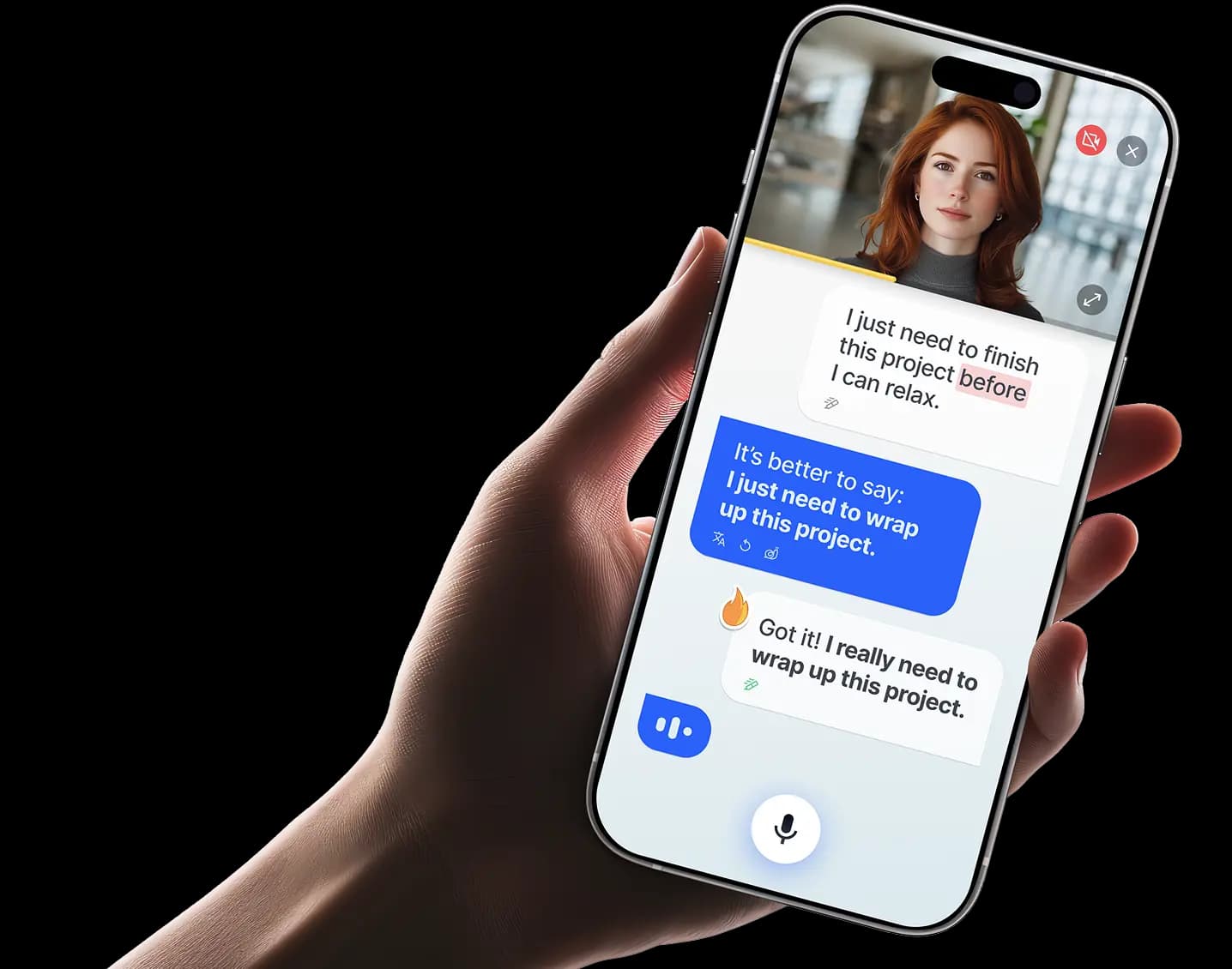
This means finding time in your busy schedule to invest in your English. An AI-powered English conversation app like Loora fits in your pocket, costs a fraction of traditional courses, and lets you master essential sales vocabulary without missing a single client meeting.
Key takeaways
Further into this guide, you'll find the following takeaways:
- Essential sales vocabulary that actually matters
- Why expensive business English courses miss the mark
- How Loora AI practice beats classroom learning for busy sales professionals
- Confidence-building techniques that translate to immediate results
The challenges of English communication in sales
It shouldn’t take you long before you find a great sales English course online. There are excellent choices out there these days. However, the first set of problems comes around when trying to learn what actually matters in sales: the ability to listen actively, communicate with crystal clarity, and speak with confidence in the moment.
You might know the vocabulary, but can you pick up on a prospect's hesitation during a discovery call? Can you pivot your pitch mid-conversation when you sense they're not connecting? Can you handle objections without stumbling over your words?
Traditional courses teach you English. They don't teach you to listen for buying signals, to clarify complex solutions without overcomplicating, or to project confidence when a client pushes back on pricing. You get static lessons on business vocabulary or generic email templates, but sales is a dynamic conversation. You need practice that adapts to how you actually sell.
Through all these, the fear of speaking inadequately looms. You might be nervous about an important client presentation, but you may also feel anxious that you're not getting enough practice to sound more professional.
This creates a vicious cycle that you’d much rather break out of ASAP. The ultimate challenge, then, is finding a solution that fits into your actual life and budget.
The role of AI in revolutionizing language learning
AI is shaping up to be the language learning you need, thanks to the technology making quality language practice accessible to busy sales professionals who need quick results. Below are ways AI is changing language learning for good:
- Cost efficiency: AI-powered language practice applications like Loora cost a lot less than traditional training, while delivering personalized feedback.
- Flexible scheduling: With apps like Loora, you can pick up language learning practice whenever you have time. Imagine practicing at 6 AM before your first call, during lunch between meetings, or at 11 PM after a long day of client presentations.
- Immediate feedback: Traditional courses may bundle feedback till after a class or test. AI gives them to you instantly, analyzing your pronunciation, grammar, and communication effectiveness in real time.
- Personalized content: Business English courses are great, but they often struggle to distinguish between different industries. Not so with AI learning apps like Loora. They can focus on the specific vocabulary, scenarios, and communication patterns relevant to your industry and sales approach.
Loora as your AI-powered partner for sales communication
Loora is an innovative language app that solves communication practice challenges in ways that actually make sense in a particularly busy sales process. Below are some of its key features:
- Role-plays: Loora’s Role-Play feature allows you to practice specific sales situations such as qualifying a skeptical prospect, handling price objections for your actual product, or explaining technical features to non-technical decision-makers.
- Real-time feedback: Loora gives you immediate corrections during conversations, complete with detailed grammar and pronunciation feedback afterward. This creates an instant feedback and improvement loop that builds the kind of muscle memory you need when a real prospect asks tough questions.
- 24/7 availability: Loora is always available online, so you don’t have to worry about scheduling conflicts or missing a session because a hot lead finally called back. You can always pick up from where you left off. It’s even got video call mode for more realistic presentation practice when you have privacy.

Key sales vocabulary all professionals need to know
Below are words and phrases that confident sales professionals need to have in their vocabulary:
Prospecting and lead qualification
These expressions are useful for addressing sales leads and prospects within a pipeline.
Essential qualifying questions
- "What's driving this decision?" - This question helps you get to the real motivation behind a lead's interest.
- "Who else is involved in the evaluation process?" - Answer to this question lets you identify decision-makers early.
- "What does success look like for your team?" - An expression that lets you uncover specific success targets and metrics
- "When do you need this implemented?" - Establishes timeline and urgency
Lead assessment
- Qualified prospect - one of the potential customers who has a budget, authority, need, and timeline that fit the current sales pipeline
- Decision-maker - The person with authority to approve the purchase
- Stakeholder - Anyone who influences or is affected by the buying decision
- Pain point - A specific problem your product or service can solve
Product and service presentation
These terms are suitable for the product or service, and how best to present them for sale.
Value proposition
- "This delivers measurable ROI through..." - This helps connect features to financial benefits.
- "The key differentiator is..." - This expression highlights your competitive advantage.
- "This addresses your specific need for..." - Shows you understand their requirements.
- "The implementation process involves..." - Sets clear expectations for next steps.
Technical explanation
- Feature - What your product or service does
- Benefit - How that feature helps the customer
- Use case - A specific scenario where your solution applies
- Integration - How your solution works with their existing systems
Objection handling and negotiation
These terms allow you to navigate objections raised by prospects during a sales drive.
Common objection responses
- "I understand your concern about..." - Acknowledges their worry without dismissing it.
- "Many clients initially felt the same way until..." - Uses social proof to address hesitation.
- "Let me clarify how this works in practice..." - Addresses misunderstandings directly and effectively.
- "What if we could structure this differently?" - Opens negotiation possibilities.
Negotiation terms
- Terms and conditions - The specific details of your agreement
- Investment - A Professional way to discuss price or cost
- Value exchange - What both parties gain from the deal
- Timeline - When different phases of implementation occur
Closing and relationship management
These terms enable you to close deals with prospects confidently.
Deal-closing phrases
- "Based on our conversation, it sounds like..." - Summarizes their needs and your solution
- "What questions do you have before we move forward?" - Identifies final concerns
- "Let's get you started with..." - Assumes the sale while outlining next steps
- "I'll send over the agreement for your review" - Moves toward formal commitment
Customer relationship terms
- Follow-up - Scheduled contact after initial meetings or purchases
- Account management - Ongoing relationship maintenance with existing clients
- Expansion opportunity - Chances to sell additional products or services
- Success metrics - How you'll measure the customer's results
Tips on applying your English communication skills for real-world success
Are you already building on your sales vocabulary? Congrats! Below are tips that can help you use them confidently when a prospect asks you those tough questions at 3 PM on a Friday:
Practice the scenarios that actually happen
In many business English courses, you’re likely to find role-playing exercises around generic corporate situations. That’s okay for beginners, but you’ll eventually need some sales-specific scenarios.
You can practice the actual conversations that generate revenue in your industry, which could be explaining pricing to budget-conscious customers or walking technical teams through implementation timelines.
Set up these specific scenarios based on your upcoming week. Do you have a product demo scheduled? Practice explaining your key features in simple terms. Use AI tools like Loora to run through these situations until your responses feel natural.
Use structured frameworks
Sales calls can get unpredictable fast, with customers asking unexpected questions or bringing up concerns you weren't prepared for. A structured framework in English helps you respond professionally even when you're thinking on your feet.
For handling objections, use the formula: ACRC (acknowledge, clarify, respond, confirm). Here’s what that looks like: "I understand your concern about implementation time. Can you help me understand what timeline you're working with? Based on similar clients, we typically see... Does that address your main worry?"
Loora can help you practice sentences like these. You can prompt the application about practicing the ACRC formula, and ask it to throw you some tricky questions.
When presenting solutions, follow the problem-solution-benefit-next steps format. These frameworks keep your English organized even when the conversation gets chaotic.
Leverage technology for continuous improvement
English improvement shouldn’t be a separate project from the main sales operations. Integrating practice into your existing routine is entirely feasible. If you have 10 mins instead of being tempted to scroll through emails, make this into your English language learning time.
AI-powered conversation tools like Loora help you practice real sales scenarios whenever you have those few minutes, which is mighty useful if you want to see improvement in actual customer interactions quicker.
FAQs
What are power words in sales?
These are terms that create emotional responses and influence action from prospects. Some power word examples are:
- Proven
- Guaranteed
- Exclusive
- Limited
- Results
Generally, power words trigger psychological responses that make customers more likely to engage. So when you use them naturally in context, it helps your conversation build trust and urgency.
What are trigger words in sales?
Trigger words are phrases that either advance or kill sales conversations, depending on your aim as the salesperson.
Positive triggers include "investment" instead of "cost," "challenge" instead of "problem," and "opportunities" instead of "pitches."
Negative triggers are used to create resistance. They include words like "cheap," "contract," "sign here," or "deal." You’d want to practice and learn English for sales enough to guide prospects toward positive decisions naturally.
How do I improve my selling skills?
Focusing on these three things will help: practicing real scenarios, getting immediate feedback, and focusing on conversations that actually matter to your line of business.
Traditional sales training may help you lay the right vocabulary foundations, but your skills truly improve when you start repeating realistic situations.
You can use AI conversation practice, such as the one Loora offers, to rehearse objection handling, product presentations, and closing techniques in a judgment-free environment.
Do you need basic English or business English for sales?
Not necessarily.
Basic English won't give you the confidence to handle complex negotiations or technical discussions. Also, business English focuses too much on formal writing and generic corporate scenarios.
What you need is sales-specific English. It helps you hit a conversational yet professional tone; clear yet persuasive, with vocabulary, phrases, and communication patterns that specifically help you better interact with prospects and close deals.
How do you start a sales conversation?
Focus on the prospect, not your product.
So, instead of "I'd like to tell you about our solution," try "I noticed your company is expanding into new markets. What's driving that growth strategy?".
Some of the best opening lines are questions that get prospects talking about topics they care about. Once they're engaged in conversation, you can guide them toward how your product or service might help address their needs.
Engage in personalized conversations with Loora, the most advanced AI English tutor, and open doors to limitless opportunities.